

DC Circuit Breaker (DC MCB) for Solar Systems – Interactive Quiz & Guide
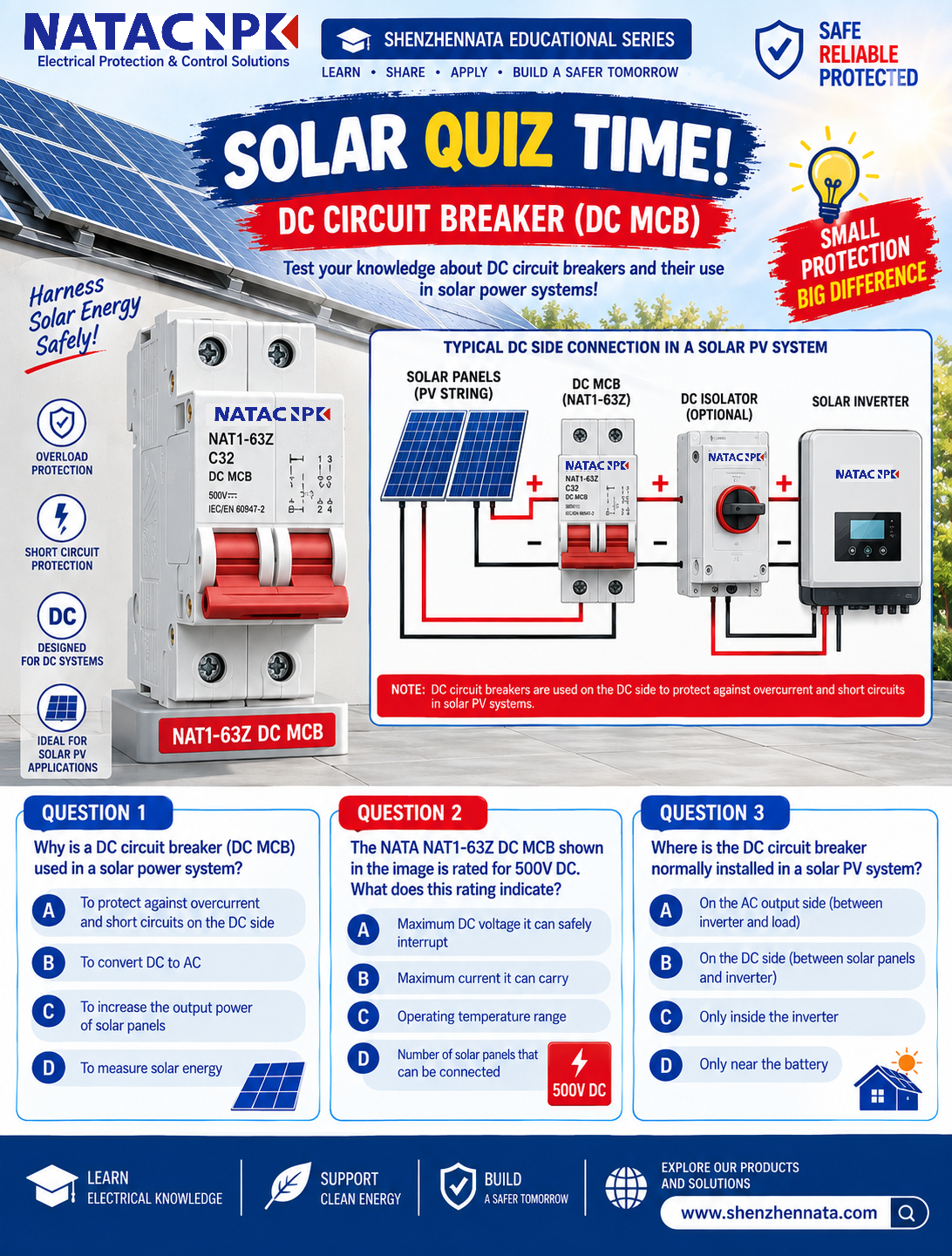
DC circuit breakers are an important part of many solar PV protection schemes. Study the Shenzhen Nata quiz below, answer the three questions, then check the explanations and practical selection guidance.
What Is a DC Circuit Breaker?
A DC circuit breaker (DC MCB) is designed for direct-current circuits. In a solar PV installation, a correctly selected DC breaker can protect suitable circuits against overcurrent and short-circuit faults and can provide a means of switching or isolation where its design and the installation rules permit.
Solar panels produce DC electricity, so protective devices on the PV side must be specifically rated for DC voltage and current. A breaker intended only for AC service should not automatically be used on a solar DC circuit.
Quiz Answers & Explanations
Try the three questions in the image before opening the answers.
Question 1: Why is a DC circuit breaker used in a solar power system?
Best answer: A — To protect against overcurrent and short circuits on the DC side.
A correctly selected DC MCB is intended to interrupt abnormal current within its ratings. It does not convert DC to AC, increase panel output or measure solar energy.
Question 2: The NAT1-63Z shown is rated for 500V DC. What does this indicate?
Best answer: A — The maximum DC voltage for which the shown breaker configuration is rated.
The voltage rating is not the breaker's current rating or temperature range. PV open-circuit voltage can rise in cold conditions, so designers must check the maximum expected string voltage against the breaker's DC rating and manufacturer configuration.
Question 3: Where is the DC circuit breaker normally installed in a solar PV system?
Best answer: B — On the DC side, between the solar array/string and inverter.
The precise arrangement varies by system, but PV DC protection belongs on the DC side. AC output protection is a separate part of the installation and requires appropriately rated AC devices.
Why DC Protection Is Different from AC Protection
In an AC circuit, current crosses zero naturally every cycle, which assists arc extinction. DC current does not have the same natural zero crossing. For that reason, the internal design, pole arrangement and voltage rating of a DC breaker matter when interrupting a DC fault.
Always follow the manufacturer's wiring and pole-connection instructions. Never assume that an AC breaker has an equivalent DC breaking capability.
Understanding the 500V DC Rating
The 500V DC marking shown on the educational product indicates the rated DC voltage for the specified breaker configuration. The PV system must be designed so that its maximum possible DC voltage remains within the rating of every device in the DC path.
Solar designers normally check the PV string's maximum open-circuit voltage, including the effect of low ambient temperature, rather than comparing the breaker only with the panel's nominal operating voltage.
Where Does the DC MCB Fit in a Solar System?
| Component | Role |
|---|---|
| Solar panels / PV string | Generate DC electrical power from sunlight |
| DC MCB / breaker | Provides appropriately rated DC overcurrent/short-circuit protection and switching where applicable |
| DC isolator | Provides dedicated DC isolation where required by the design and rules |
| DC SPD | Helps limit transient overvoltage when specified |
| Solar inverter | Converts PV DC power to usable AC power and manages the system according to its design |
How to Select a DC MCB for Solar PV
- DC voltage rating: must exceed the maximum expected system/string voltage for the specified configuration.
- Current rating: must be coordinated with PV source current, conductor capacity and system design.
- Breaking capacity: must be suitable for the prospective DC fault current.
- Number of poles and wiring: follow the manufacturer's required DC connection arrangement.
- Polarity: observe polarity requirements where the breaker is polarity sensitive.
- Environment: consider enclosure, temperature, altitude and installation conditions.
- Standards and documentation: verify the exact model's ratings and certifications for the intended application.
DC MCB vs DC Isolator
A DC MCB and a DC isolator should not automatically be treated as the same device. A breaker is intended to interrupt fault/overcurrent within its specified ratings, while an isolator is primarily intended to provide safe disconnection. Some equipment may combine functions, but this must be confirmed from the manufacturer's specifications.
DC MCB vs DC Fuse
Both can be used for overcurrent protection in suitable PV designs. A fuse operates by melting its element when current exceeds its characteristics and must then be replaced. A circuit breaker trips mechanically and can normally be reset after the fault has been identified and corrected. The appropriate choice depends on the array configuration, fault-current requirements, coordination and applicable standards.
Common Solar DC Protection Mistakes
- Using an AC-only MCB on a DC PV circuit.
- Selecting a breaker only by ampere rating while ignoring maximum DC voltage.
- Ignoring the manufacturer's required pole connection.
- Failing to consider cold-weather PV open-circuit voltage.
- Confusing a DC breaker with a dedicated DC isolator.
- Using cables or connectors that are not coordinated with the protective device.
- Ignoring surge protection and earthing requirements where applicable.
Shenzhen Nata NAT1-63Z DC MCB
The educational image features the Shenzhen Nata NAT1-63Z DC MCB. For product details and available configurations, visit the DC Miniature Circuit Breaker page or browse Solar Protection Devices.
Frequently Asked Questions
Can I use a normal AC MCB for solar DC?
Do not assume so. Use a device with an explicit DC rating suitable for the system voltage, current, pole configuration and fault conditions.
What does 500V DC mean on a breaker?
It is a voltage rating for the specified DC breaker configuration. It does not mean the breaker carries 500 amps or produces 500 volts.
Is a DC MCB installed before or after the inverter?
PV DC protection is installed on the DC side before the inverter input. The inverter's AC output requires separate AC-side protection.
Does a DC MCB replace an SPD?
No. A breaker addresses overcurrent/short-circuit protection, while an SPD is intended to limit transient overvoltage. They perform different functions.
SHENZHENNATA Educational Series
Learn practical electrical and solar concepts through visual diagrams, quizzes and detailed explanations.
Explore all Educational Series posts →Explore Shenzhen Nata Solar Protection Products
Browse DC circuit breakers, fuse holders, surge protection devices, MC4 connectors and related solar protection products.
View DC MCB Solar Protection Visit Shop