

Hybrid Solar System House Wiring Explained – Interactive Quiz & Guide
How does a hybrid solar system power a house when solar panels, a battery and the utility grid are all available? Study the Shenzhen Nata educational diagram, test yourself with three quick questions, then read the explanations below.
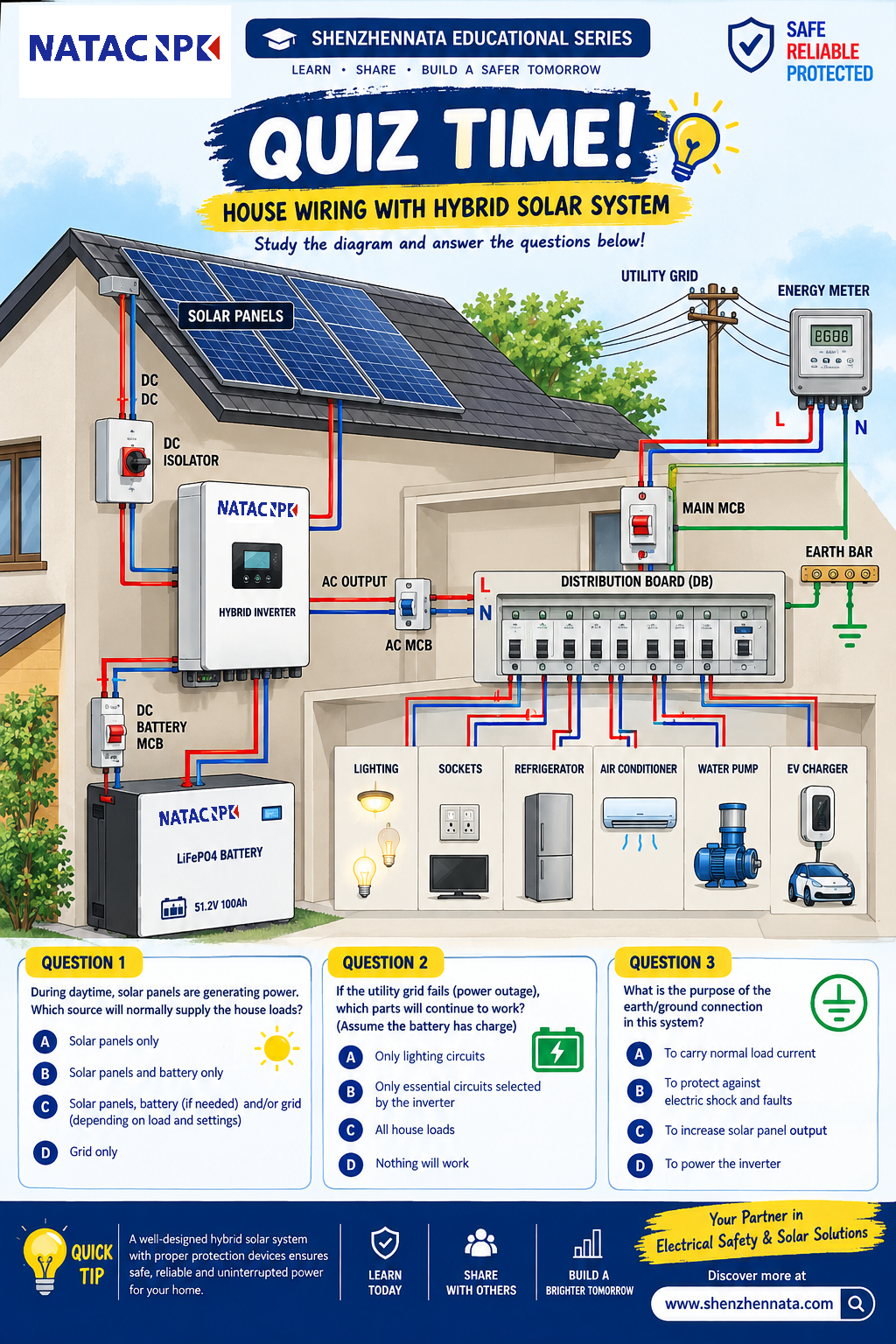
How a Hybrid Solar System Works
A hybrid solar system combines solar panels, a hybrid inverter, battery storage and the utility grid. The inverter manages power between these sources and the home's AC loads according to available solar energy, battery state of charge and configured operating priorities.
The battery is connected on the DC side through suitable battery protection, while the grid connects on the AC side through the meter and main protection. Proper earthing and protective devices are essential parts of the system rather than optional extras.
What Do the Main Components Do?
Solar panels
Solar panels generate DC electricity from sunlight. Their output is sent toward the inverter through correctly rated DC cabling, isolation and protection.
DC isolator
A DC isolator provides a means of disconnecting the photovoltaic DC circuit for maintenance or emergency isolation when correctly selected and installed for the system voltage and current.
Hybrid inverter
The hybrid inverter converts DC energy from the solar array or battery into AC electricity for household loads. Depending on its design and settings, it can also coordinate grid power and battery charging/discharging.
Battery and DC battery MCB
The battery stores energy for later use. Battery circuits can deliver high fault current, so protection must be specifically suitable for the battery voltage, current, cable size and DC interruption requirements.
AC MCB and main MCB
MCBs provide overcurrent protection for suitable AC circuits. Their ampere rating, breaking capacity and pole configuration must match the electrical design. An AC breaker must not automatically be substituted on a DC circuit.
Distribution board (DB)
The distribution board divides power into individual circuits such as lighting, sockets, refrigerator, air conditioner, water pump and other dedicated loads. Each outgoing circuit should have protection appropriate to its cable and load.
Earth / ground connection
Protective earthing helps create a low-impedance fault-current path and supports operation of protective devices. It is an important part of reducing electric-shock and equipment-fault risks.
Quiz Answers & Explanations
Try answering the three questions on the image before opening the explanations.
Question 1: Which source normally supplies the house loads during daytime?
Best answer: C — Solar panels, battery (if needed), and/or grid depending on load and settings.
In a hybrid system, the exact source mix depends on solar generation, load demand, battery charge and inverter priorities. Solar commonly supplies available daytime demand first, while the battery and/or grid can assist when required.
Question 2: If the utility grid fails, which parts continue to work?
Best answer for the illustrated backup arrangement: B — Only essential circuits selected by the inverter.
Many hybrid systems have a dedicated backup or essential-load output. During a grid outage, only circuits connected to that backed-up output continue operating, provided the inverter, solar and battery can support them. Some systems can be designed differently, so this is not a universal rule.
Question 3: What is the purpose of the earth/ground connection?
Best answer: B — To help protect against electric shock and faults.
Protective earthing is not intended to carry normal load current. It supports fault protection by providing a path for fault current and helping protective devices operate as designed.
Why Hybrid Solar Systems Need Both DC and AC Protection
A hybrid installation contains two very different electrical environments. The PV array and battery operate on DC, while most household distribution is AC. Each side needs devices specifically rated for that application.
| System Area | Typical Protection / Isolation | Main Purpose |
|---|---|---|
| PV DC side | DC isolator, DC breaker/fuse, DC SPD as required | Isolation, overcurrent and surge protection |
| Battery DC side | Battery-rated DC protection | Protect battery cabling and equipment against fault current |
| Inverter AC side | Suitable AC circuit breaker | Overload and short-circuit protection |
| Main / distribution board | MCB/MCCB, RCCB/RCBO, SPD as applicable | Coordinated protection of circuits and users |
| Earthing system | Protective earthing and bonding | Support fault protection and reduce shock risk |
What Happens During a Grid Outage?
When utility power fails, a properly configured hybrid inverter can separate its backed-up circuits from the grid and continue supplying those circuits from solar and/or battery energy. This anti-islanding behaviour is important because a solar system must not unintentionally energize the public grid during an outage.
Whether the whole house or only selected loads remain powered depends on the inverter capacity, battery capacity, wiring arrangement and system design. High-demand loads such as air conditioners, pumps or EV chargers may be excluded from backup circuits where necessary.
Why Essential Loads Are Often Separated
Battery energy is limited. Keeping only priority loads on the backup side can extend operating time during outages. Typical essential loads may include selected lighting, communications equipment, refrigerators and other priority circuits chosen by the system designer and homeowner.
Common Hybrid Solar Wiring Mistakes to Avoid
- Using AC-only breakers on DC circuits without a verified DC rating.
- Choosing breaker ratings without checking cable current-carrying capacity.
- Ignoring PV and battery fault-current requirements.
- Putting every high-power household load on the backup output without checking inverter capacity.
- Incorrect or incomplete earthing and bonding.
- Missing or incorrectly selected surge protection where required.
- Installing isolators or protective devices with insufficient DC voltage ratings.
- Assuming all hybrid inverters use the same wiring arrangement.
Protection Devices Used in Solar Installations
Shenzhen Nata supplies electrical protection products used in residential, commercial and solar applications. Depending on the system design, relevant product categories can include DC miniature circuit breakers, DC fuse holders, surge protection devices, solar MC4 connectors and AC circuit breakers.
For a broader overview, see our solar protection devices page and solar electrical protection guide.
Frequently Asked Questions
Can a hybrid solar system work without the grid?
Many hybrid systems can power selected backup loads during a grid outage when sufficient solar or battery energy is available. The exact capability depends on the inverter and how the system is wired.
Can a hybrid inverter power the whole house during an outage?
Sometimes, but not automatically. It depends on inverter output capacity, battery capacity, starting currents of large appliances and the backup-circuit design.
Why does a solar system need a DC MCB or fuse?
DC overcurrent protection helps protect suitable DC circuits and cables against fault current. Devices must be specifically rated for the system's DC voltage and interruption requirements.
Is an earth connection the same as a neutral?
No. Neutral and protective earth have different functions. They must be connected and routed only as permitted by the system design and applicable electrical rules.
Should an EV charger be placed on solar backup?
That depends on available inverter and battery capacity. EV charging is a high-demand load and is often managed separately unless the system has been intentionally sized for it.
About the SHENZHENNATA Educational Series
This series turns practical electrical and solar concepts into diagrams, quizzes and short technical guides. Follow the series on social media, then use the website explanations to check your answers and learn the reasoning behind them.
Explore all Educational Series posts →Explore Shenzhen Nata Solar Protection Products
Find circuit breakers, surge protection, fuse holders, solar connectors and related electrical protection products for solar and distribution applications.
Solar Protection Products Visit Shop Contact Shenzhen Nata