

How to Size a DC MCB for Solar Panels: A Practical PV Protection Guide
Choosing a DC miniature circuit breaker for a solar PV system is not simply a matter of matching its ampere rating to the inverter. You must check the array's maximum DC voltage, fault-current characteristics, conductor ratings, pole configuration and the breaker's certified DC interruption capability. This guide explains the process and where Shenzhen Nata DC protection products fit.
What does a DC MCB do in a solar system?
A properly rated DC circuit breaker can interrupt overcurrent or short-circuit faults within its published ratings. Some models can also be used for switching or isolation, but only where their product documentation and local installation requirements permit. Unlike AC breakers, DC breakers must interrupt arcs without relying on the AC waveform's natural current zero crossing.
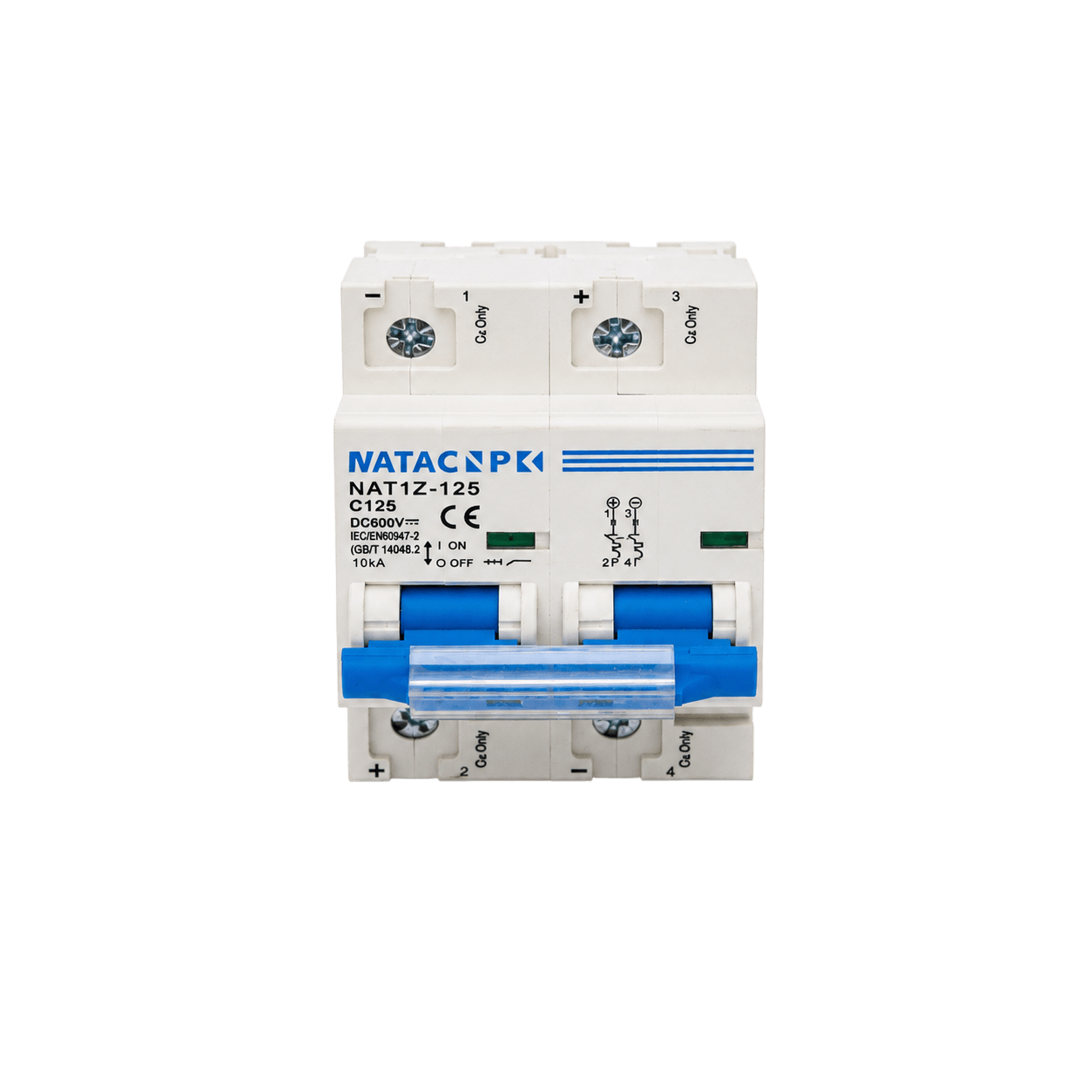
Explore Shenzhen Nata DC MCB models and specifications before choosing a rating. The image above is the original product file from this website, displayed without modification.
DC MCB sizing: the five checks that matter
1. Determine the maximum PV string voltage
Read the solar module's open-circuit voltage (Voc) and temperature coefficient. The maximum possible string voltage rises as cell temperature falls. Calculate the worst-case cold-weather Voc using the module manufacturer's method and your site's minimum design temperature. The breaker's DC voltage rating must cover that maximum for the specified pole wiring arrangement. Never assume that a printed 500 V DC rating applies to every possible pole configuration.
2. Understand string short-circuit current (Isc)
The module datasheet gives the short-circuit current, Isc. String current, the number of parallel strings and the possibility of reverse current from other strings all affect protection requirements. A single PV string often behaves differently from several parallel strings: not every string needs an overcurrent device when fault-current sources cannot exceed the module or conductor limits. Check the module's maximum series-fuse rating and the design standard before adding or omitting protection.
3. Coordinate the breaker with the cable
A breaker's current rating must be selected alongside the cable's allowable current under real installation conditions, including ambient temperature, grouping and routing. Do not increase the breaker size simply to stop nuisance trips. The cable and downstream equipment must remain adequately protected.
4. Check DC breaking capacity and polarity
Confirm the breaker's published DC short-circuit breaking capacity, voltage, applicable standard and any polarity or directional requirements. A high ampere rating does not prove that the breaker can interrupt the available fault current. Follow the manufacturer's terminal markings and pole-connection diagram exactly.
5. Check whether a breaker, fuse, isolator or SPD is needed
These devices serve different functions. A DC fuse may be specified for PV string overcurrent protection; a DC isolator provides the required disconnection function; an SPD limits transient overvoltages; and a DC MCB provides circuit protection within its rated capabilities. The final design may require more than one device.
Illustrative selection example (not a product recommendation)
Suppose a PV module has Voc = 49 V at standard test conditions, a Voc temperature coefficient of −0.28% per °C, and ten modules connected in series. For an illustrative cell temperature of −5°C, the difference from the 25°C reference is 30°C. Estimated cold-weather string Voc is 10 × 49 × [1 + (0.0028 × 30)] ≈ 531 V DC. A breaker rated only 500 V DC in its specified configuration would therefore not be suitable for this example. This is a voltage check only—not a complete breaker selection.
Why you cannot select a DC breaker using inverter wattage alone
Dividing inverter power by a nominal voltage does not tell you the PV array's maximum open-circuit voltage, string Isc, reverse-current exposure, conductor rating or fault interruption requirements. Those values come from the module, array configuration, inverter input limits and installation design.
Solar DC MCB vs DC fuse holder
PV-rated fuses are frequently used in combiner-box string protection when multiple strings can feed reverse current into a faulted string. DC MCBs may be used where their ratings, characteristics and applicable rules make them appropriate. The devices are not automatically interchangeable; compare their rated voltage, fault-interruption capability, operating characteristics and manufacturer instructions.
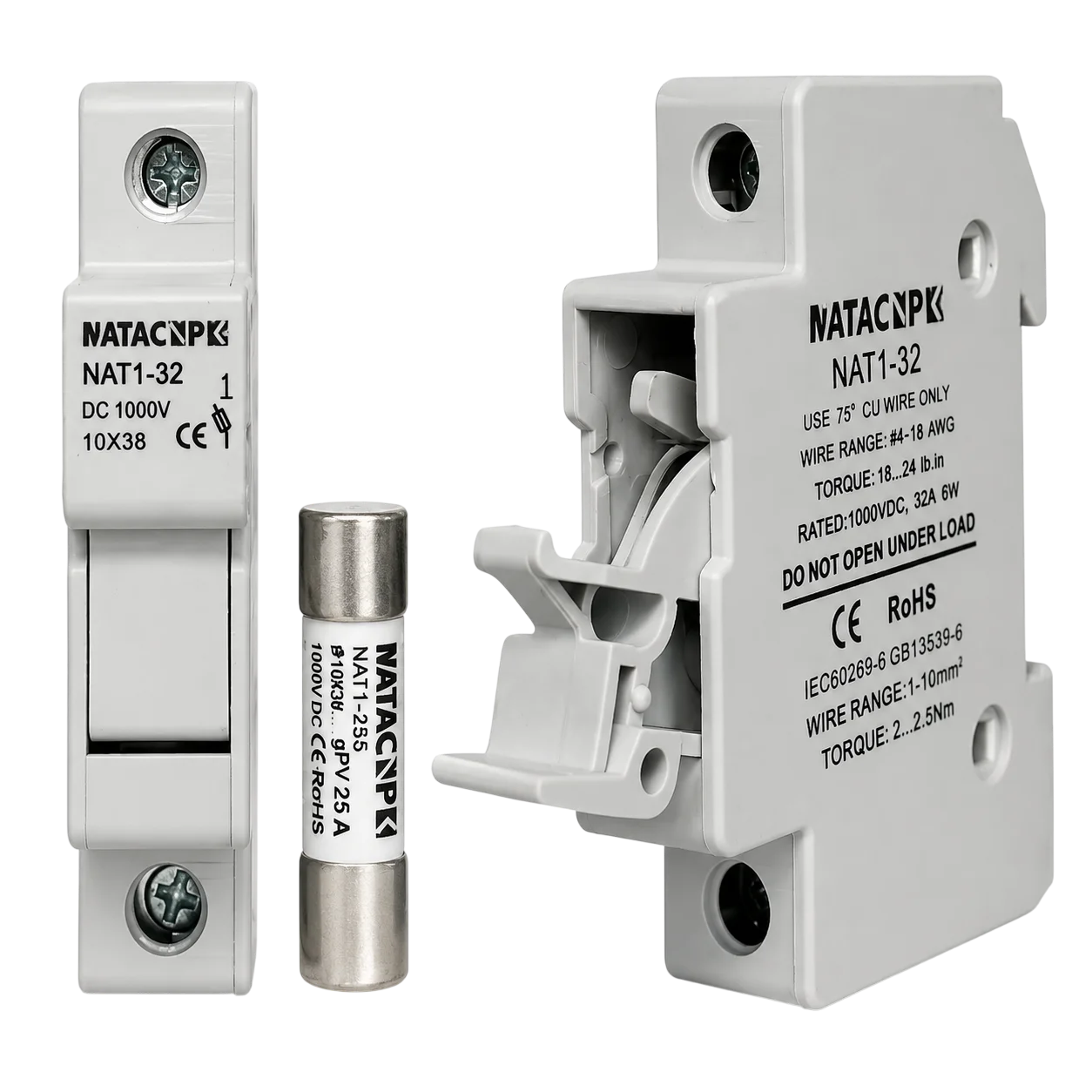
For PV string protection components, see the Shenzhen Nata DC fuse holder range and solar protection products.
Common mistakes that lead to poor protection
- Using an AC-only MCB on a DC circuit without a verified DC rating.
- Choosing 500 V DC hardware without checking cold-weather array Voc.
- Assuming a 32 A or 63 A marking is automatically suitable for a particular PV string.
- Ignoring cable ampacity, module maximum series-fuse rating or parallel-string reverse current.
- Using a breaker as an isolator without verifying its suitability for isolation.
- Confusing an overcurrent breaker with a DC surge protection device.
Buyer checklist for Pakistan solar projects
- Collect module and inverter datasheets and draw the string layout.
- Calculate maximum cold-weather PV voltage.
- Determine Isc, number of parallel strings and required overcurrent protection.
- Verify cable capacity and module maximum series-fuse rating.
- Match DC voltage, breaking capacity, poles and wiring diagram to the exact device datasheet.
- Confirm enclosure, isolation, SPD and earthing requirements with the installer.
Frequently asked questions
Can I use an AC MCB for solar panels?
Not unless the manufacturer explicitly rates that exact device and wiring configuration for the relevant DC voltage and interruption duty. Choose purpose-rated DC protection for PV circuits.
Is a 500 V DC breaker suitable for every 500 V solar system?
No. The maximum PV open-circuit voltage under cold conditions can exceed nominal operating voltage, and the device's DC rating can depend on pole configuration.
Does every solar string require a DC MCB?
No. The need for string overcurrent protection depends on the array design, available reverse current, module limits and applicable rules. Do not install or omit it solely based on a generic diagram.
What is the difference between a DC MCB and a DC isolator?
A DC MCB provides overcurrent protection within its ratings; an isolator provides a defined disconnection function. Some devices may be suitable for both purposes, but that must be verified.
Find suitable Shenzhen Nata solar protection products
Explore the DC MCB product range, DC fuse holders, solar protection solutions and online shop. For dealers, installers, panel builders or bulk orders in Pakistan, contact Shenzhen Nata with your module/inverter specifications and project requirements.
Further reading: DC MCB solar quiz · Solar electrical protection guide · AC vs DC circuit breakers.