

Generator Changeover Switch vs ATS vs MTS: Complete Guide for Pakistan
When electricity from the grid fails, many homes, shops and industrial facilities in Pakistan use a generator as a backup source. But switching between grid and generator power needs more than an ordinary on/off switch. This guide compares a manual generator changeover switch, an automatic transfer switch (ATS) and a manual transfer switching (MTS) interlocking breaker arrangement—with practical selection questions and links to Shenzhen Nata's relevant product categories.
Quick answer: What is the difference?
A manual changeover switch changes the connected supply when someone operates it. An ATS monitors supply conditions and transfers automatically when properly designed and configured. An MTS interlocking breaker typically uses a mechanical interlock to prevent two source-side switching devices from being closed simultaneously; in the Shenzhen Nata product category discussed here, it is manually operated rather than an automatic ATS.
Manual changeover switch: How does it work?
A manual changeover device allows an authorized operator to select between sources, often the public utility and a standby generator. Suitable transfer designs provide a defined switching sequence and prevent unsafe parallel connection of sources. The number of poles, neutral handling, operational category and permissible switching current must match the actual system design.
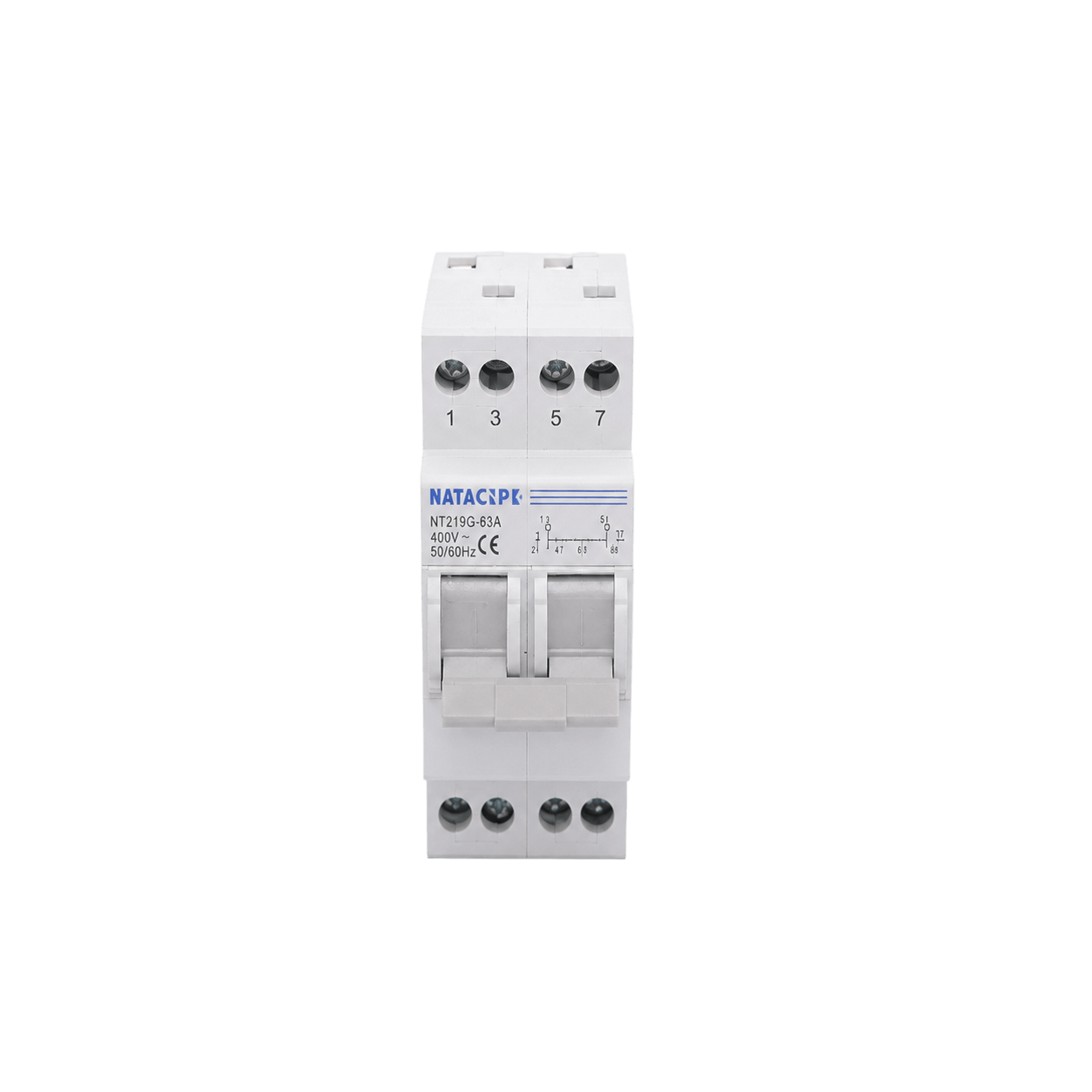
Shenzhen Nata lists the NT219G 63A Changeover Switch (the website describes it as 63 A, 400 V AC, 50/60 Hz) and an LW26 Rotary Changeover Switch. These are distinct products: do not assume their switching positions, pole arrangements or utilization ratings are interchangeable.
When is a manual changeover useful?
- Homes and small shops where an operator is available during outages.
- Workshops and noncritical loads where a short interruption is acceptable.
- Installations where the total cost, panel space and maintenance requirements favor a manual design.
Limitations: It does not independently detect power failure, start a generator or restore the grid supply automatically. Switching under load must be permitted by the exact device ratings and operating instructions; never assume that it is.
What is an ATS (Automatic Transfer Switch)?
An ATS is a complete transfer system designed to monitor available sources and initiate switching without routine manual intervention. Depending on the generator system, it may command a generator start, wait for a usable voltage and frequency, transfer the connected load, then return to utility supply after it has stabilized. The detailed timing and controls vary by equipment.
ATS equipment normally combines a source-sensing/control function and a suitable power-transfer mechanism with interlocking. Automatic transfer does not mean uninterrupted power: a conventional open-transition ATS normally introduces a break while the generator starts and the transfer takes place. Critical uninterrupted loads may additionally require a UPS or engineered alternatives.
What does MTS mean in an interlocking breaker system?
“MTS” is commonly used to mean Manual Transfer Switch. In a mechanically interlocked arrangement, the switching devices are constrained so that the two supplies cannot be connected to the load at the same time when the arrangement is installed and operated according to its design. This is important for preventing source paralleling and dangerous backfeed.
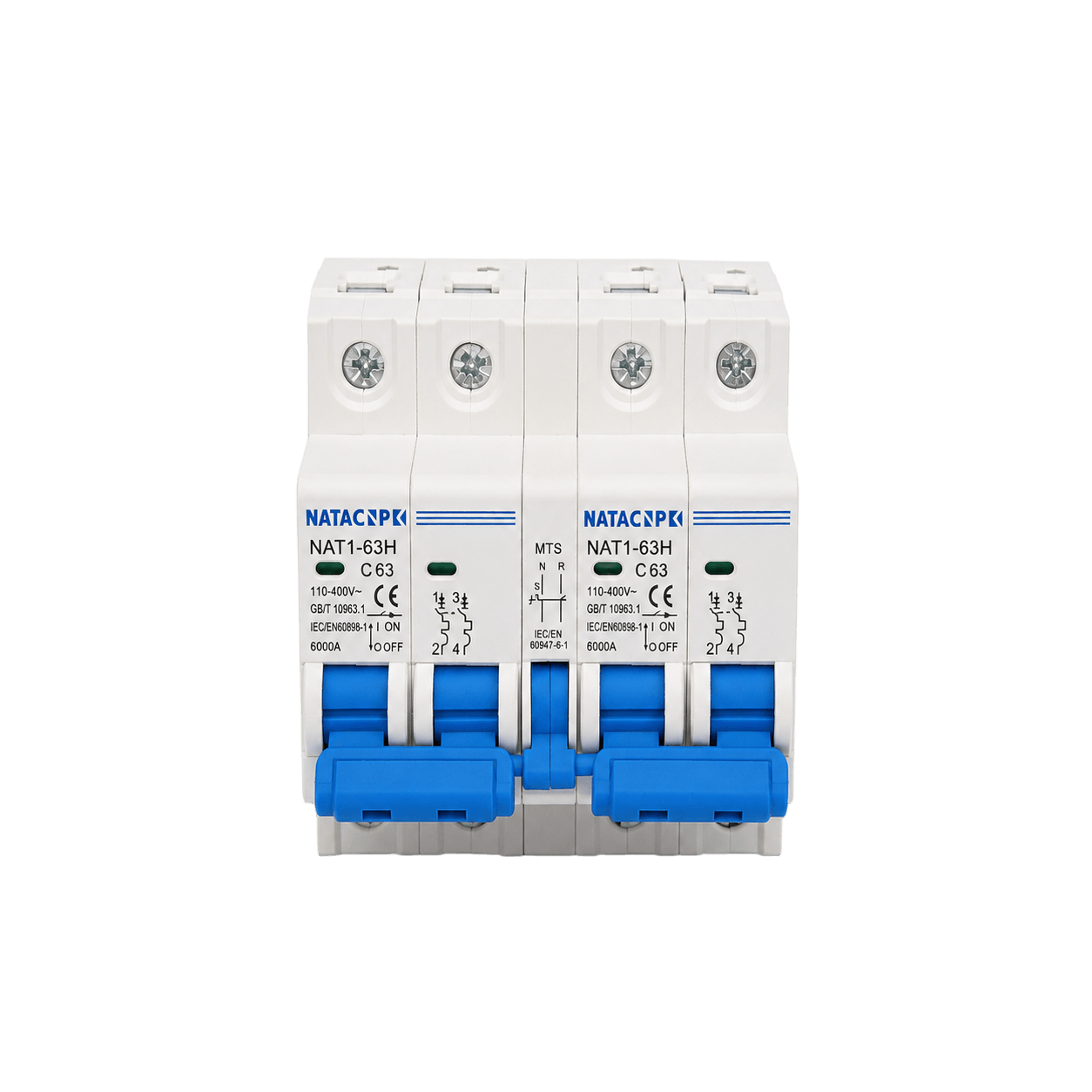
The Shenzhen Nata NAT1-63H C63 MTS Interlocking Breaker is presented as a manual, mechanically interlocked transfer option. Product names alone do not establish the completed assembly's suitability for a particular generator, fault level or installation.
Generator changeover switch vs ATS vs MTS: Comparison table
| Selection point | Manual changeover switch | ATS system | MTS interlocking breaker |
|---|---|---|---|
| How transfer begins | Operator action | Automatic control, as configured | Operator action |
| Power source sensing | Not inherent | Normally provided by controller | Not inherent |
| Generator auto-start | Not inherent | Possible with compatible controls | Not inherent |
| Source interlocking | Depends on device switching design | Required in correctly designed system | Mechanical interlocking feature |
| Operator required for transfer | Yes | Normally no | Yes |
| Typical use | Small manual backup supplies | Applications requiring unattended changeover | Manually transferred, interlocked breaker panels |
| What to verify | Poles, changeover sequence, utilization ratings | Control logic, transfer rating, generator compatibility | Interlock, breaker ratings, assembly compliance |
Practical example: A small shop in Pakistan
Consider a shop with lighting, fans, computers and a backup generator. If a responsible person can operate the supply changeover and interruptions are acceptable, a correctly engineered manual switching arrangement may be appropriate. If the shop needs unattended source selection, an ATS may be worth evaluating, but the generator's starting system and the allowable interruption period must also be considered.
For hospitals, data systems, telecom installations and other critical facilities, equipment selection cannot be reduced to “manual vs automatic.” Transfer time, continuity requirements, fault protection, source capacity and coordination with UPS or emergency-power equipment all need professional engineering assessment.
How to choose a generator changeover arrangement: 9 checks
- Identify both sources: Utility and generator, or other approved alternate sources.
- Confirm phase system and voltage: Single-phase and three-phase installations require different equipment arrangements.
- Calculate demand: Include real operating loads, power factor where relevant and motor starting characteristics.
- Check the neutral and earthing design: Neutral switching requirements depend on the power system and applicable regulations; do not adopt a generic wiring scheme.
- Match rated current and utilization category: Check whether the device can perform the intended switching duty and the manufacturer's instructions.
- Review fault ratings: Ensure suitability for prospective short-circuit levels and coordination with upstream/downstream protective devices.
- Confirm safe interlocking: The design must avoid unintended grid-generator paralleling and backfeed.
- Decide who operates the switch: Manual operation or automatic sensing and control, including any generator-start interface.
- Verify the entire installation: Enclosure, wiring, labeling, maintenance access, testing and applicable standards all matter.
Can I select a changeover switch using amperes alone?
No. For an illustrative balanced three-phase load, line current can be estimated with:
I ≈ P / (√3 × VLL × PF), where P is active power in watts, VLL is line-to-line voltage, and PF is power factor. A 10 kW load at 400 V and 0.9 PF gives approximately 16 A. This simplified calculation does not establish a suitable switch or breaker rating. Inrush current, future load, permissible cable current, installation temperature, switching duty, protection and local regulations still need evaluation.
For single-phase resistive loads, current is approximately P/V, but motor and non-resistive loads require additional consideration. If the installation supplies both single- and three-phase equipment, the design must account for how each is distributed and protected.
Common mistakes to avoid
- Using two independent breakers without an approved interlock arrangement.
- Assuming a manual rotary product is an automatic transfer switch.
- Choosing a switch only by a headline ampere value.
- Ignoring neutral, grounding and source compatibility.
- Backfeeding a building through an ordinary socket or improvised connection.
- Claiming a transfer switch eliminates outages or replaces a UPS.
- Using wiring diagrams intended for a different product model.
Frequently asked questions
What is the difference between ATS and MTS?
An ATS normally monitors the sources and initiates switching automatically. MTS refers to manual transfer switching; the switching action is performed by an operator. Check the actual equipment description because naming practices vary.
Is a changeover switch necessary for a home generator?
A safe, code-compliant method of isolating and selecting power sources is essential when connecting a generator to building wiring. The appropriate transfer equipment must be specified for the installation by a qualified electrician.
Can an MTS interlocking breaker start a generator automatically?
Not by itself. A mechanically interlocked manual switching assembly is not an automatic transfer controller.
Does an ATS switch with zero downtime?
Not generally. Conventional open-transition ATS systems introduce an interruption. Critical systems may need a UPS or other engineered continuity arrangement.
Is a two-pole or four-pole changeover switch better?
Neither is universally better. The proper number of switched conductors depends on the phase configuration and neutral/earthing requirements. A qualified designer must select the pole arrangement.
What is the generator changeover switch price in Pakistan?
Prices depend on current rating, device type, pole configuration, switching category and supplier stock. Check the Shenzhen Nata changeover switch product page or request a current quotation; do not assume prices remain constant.
Explore Shenzhen Nata changeover and MTS products
Further reading: Circuit breaker selection guide · Commercial electrical applications · Industrial electrical applications · Knowledge Center.
Technical references and editorial note
This general explanation of ATS operation and source interlocking is consistent with Eaton's ATS instructional booklet. Specific Shenzhen Nata product descriptions in this guide are based on the corresponding pages linked above. No independent product testing is claimed. Technical specifications and regulatory suitability must be checked against current model documentation before purchase or installation.